The first real cold snap of the year always brings the same phone calls. "My windows are wet on the inside. Are they failing?" Sometimes the answer is yes. Most of the time, it is not.
Condensation is the most misunderstood window problem we see. Where the water shows up tells you almost everything. Here is how to read it, what to do about it, and when it really does mean it is time for new windows.
Why windows sweat in a Chicago winter. Warm indoor air holds moisture. When that air touches a cold surface, it cools, and the moisture turns back into water. It is the same thing that happens to a glass of iced tea on a summer porch.
In a south suburbs January, the glass is usually the coldest surface inside your house. National Weather Service normals put Chicago's average January low near 19°F, with a few nights most winters that drop below zero. Your windows sit between a 70-degree living room and that cold. The colder it gets outside, the colder the inside of the glass gets, and the less humidity it takes to fog it up.
That is why a window can be dry all fall and then drip on the first 5-degree morning. The window did not change. The weather did.
Where the water shows up tells you what is wrong.
On the outside of the glass. This is dew, the same as on your lawn. It usually shows up on cool mornings in spring and fall. It is not a problem. In fact, Andersen notes that exterior condensation is a sign of an energy-efficient window: the glass is keeping your heat inside so well that the outer pane stays cold. The sun clears it by mid-morning.
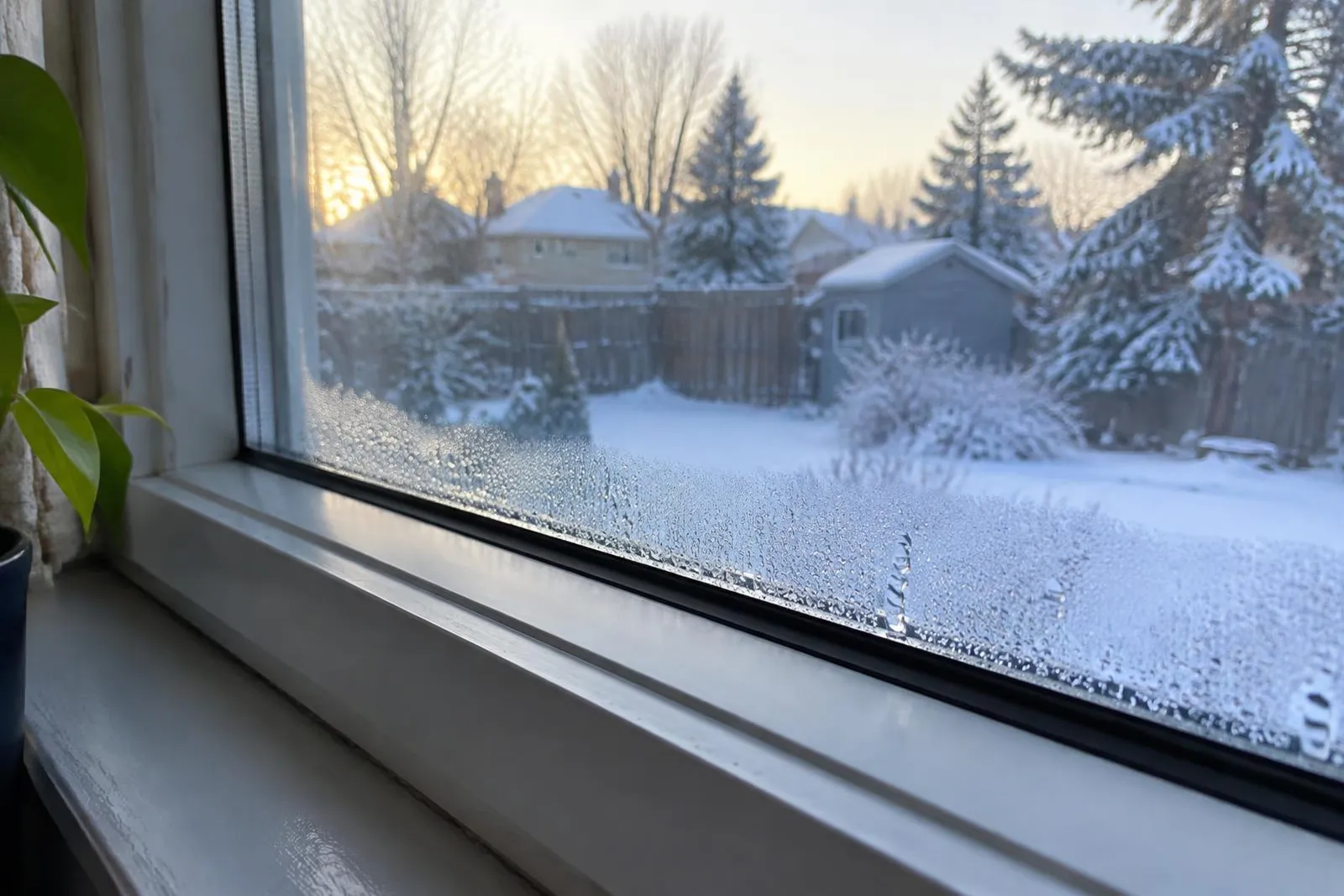
On the inside surface of the glass. This is the one most people call about. It means the air in your home has more moisture than the glass can handle at that outdoor temperature. The cause is almost always indoor humidity, not the window itself. It is fixable, and we will cover how below.
Between the panes. This is the one that matters. A double-pane window is a sealed unit. If you see fog, droplets, or a cloudy film trapped between the two layers of glass, and you cannot wipe it off from either side, the seal has failed. The insulating gas has leaked out and moist air has leaked in. No amount of dehumidifying will fix this. The glass unit or the whole window needs to be replaced.
Healthy winter humidity levels. Most window makers recommend keeping indoor humidity around 30 to 35 percent during the heating season. Andersen gives that same range. On the coldest stretches, you may need to go a bit lower. Canada's National Research Council, which has studied this for decades, puts it plainly: the colder it is outside, the lower your indoor humidity needs to be to avoid condensation.
A basic digital hygrometer costs about as much as a pizza and tells you where you stand. Many newer thermostats show humidity too. If your reading is 45 or 50 percent in January, you have found your answer.
Common moisture sources in south suburbs homes. A family of four adds a surprising amount of water to the air every day through breathing, cooking, and showers. Add a few of these and the windows start to drip: a whole-house humidifier on the furnace set too high, or never turned down when the temperature drops; bathroom fans that are missing, too weak, or not vented all the way outside; cooking without the range hood running; drying laundry on racks indoors; lots of houseplants or an aquarium; a damp basement or crawl space; or a newer, tighter house, where the moisture has fewer places to escape.
How to reduce condensation on the inside of the glass. Start with the free and cheap fixes:
1. Turn down the furnace humidifier when a cold front comes through. Many have a dial marked by outdoor temperature. Use it.
2. Run the bath fan during every shower and for 15 to 20 minutes after.
3. Use the range hood whenever you boil, simmer, or fry.
4. Open blinds and curtains during the day. Heavy drapes trap cold air against the glass and make condensation worse.
5. Run ceiling fans on low to keep air moving across the windows.
6. Check that the dryer vents outside and that the vent flap is not stuck.
If the house is newer and very tight, an HVAC contractor may suggest a heat recovery ventilator. It brings in fresh air and moves stale, moist air out without wasting much heat.
Why older windows sweat more. Here is where the window does come into it. An old single-pane window, or a 1990s double-pane with no Low-E coating, has a much colder inside surface than a modern window. That means it fogs up at humidity levels a new window handles easily. Aluminum frames make it worse, because metal pulls cold right through to the inside edge.
Modern double-pane glass with Low-E coatings, argon gas, and warm-edge spacers keeps the inside pane closer to room temperature. The result: you can keep your house at a comfortable humidity without water running down the glass. We cover the labels that matter in our article on energy-efficient windows for Chicago winters.
When condensation means it is time to act. Condensation on the glass is not an emergency. Water that sits there all winter is a different story. Check the bottom of your windows. If you see peeling paint or dark stains on the sill or trim, soft or spongy wood when you press on the frame, black spots of mold in the corners, water stains on the drywall below the window, or fog trapped between the panes that never clears, do not wait.
These are signs that moisture has moved past the glass and into the frame or wall. That is where small problems turn into rot repairs.
Get a second opinion before you replace anything. If you are seeing water on your windows this winter, try the humidity fixes first. They cost next to nothing, and they solve the problem more often than not. If the fog is between the panes, or the frames are soft or stained, it is time to have someone look.
SWS has been replacing windows across Orland Park and the south suburbs for 30+ years, and we install Marvin and Andersen windows built for our winters. Our free estimates are no pressure. If your windows are fine and your humidifier is the problem, we will tell you so. Call 708-215-2737 or request a free estimate online.