When you pick new siding, you pick a color, a style, and a brand. Then you look at it for the next 30 years. What you never see is what decides whether it lasts that long: the layers underneath and the way each panel is fastened.
Most siding problems we are called to fix in the south suburbs are not product failures. They are installation failures hiding behind a nice-looking wall. Here is what should be going on behind your siding, and the questions that tell you whether an installer knows it.
Why the hidden layers matter so much here. Chicago-area weather puts every wall through a lot. National Weather Service normals show more than 120 nights a year at or below freezing, a January average near 25°F, and humid summers in the 80s and 90s. Wind-driven rain pushes water sideways into every seam.
Siding is the first line of defense. It is not the last. Some water always gets behind it. A well-built wall is designed to let that water drain out and dry before it can soak into the wood sheathing and framing. When the hidden layers are missing or done wrong, water stays put, freezes, thaws, and rots the wall from the inside. By the time you see it inside the house, the damage is usually bigger than it looks.
Layer 1: The sheathing. Under the siding sits the sheathing, usually plywood or OSB board nailed to the wall studs. On older homes, it may be fiberboard or boards. When old siding comes off, this is the moment of truth. Soft, stained, or crumbling sheathing needs to be replaced before anything new goes on.
This is the main reason we rarely recommend installing new siding over old siding. Covering the old layer hides whatever is going on underneath. Stripping to the sheathing lets you see the wall and fix it once.
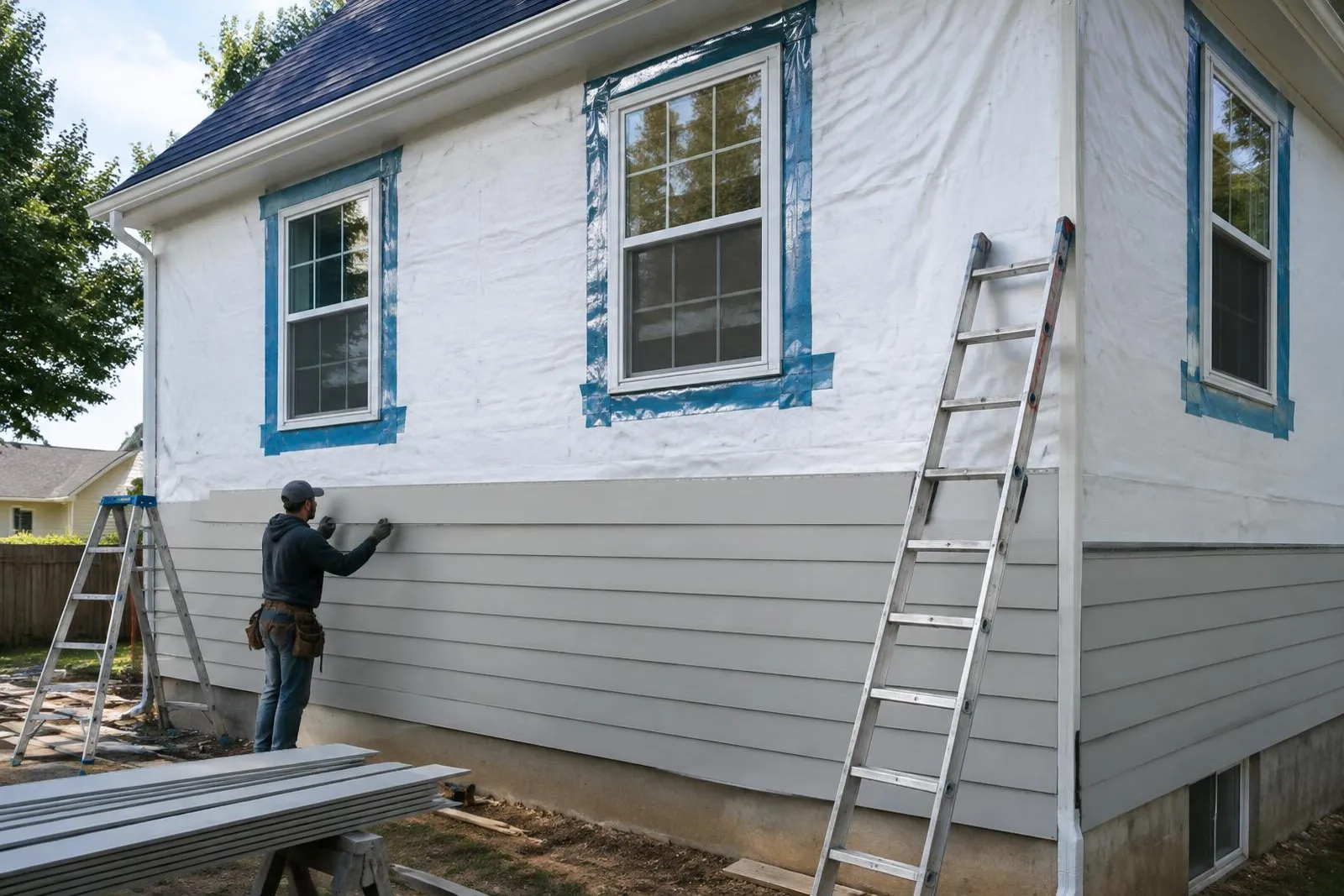
Layer 2: The water-resistive barrier, or house wrap. Next comes the water-resistive barrier, most often a house wrap. It is a sheet that sheds liquid water but lets water vapor escape, so the wall can dry. The residential building code used across much of the country requires a water-resistive barrier behind exterior siding, and James Hardie's installation instructions require one too.
What matters is how it goes on:
Shingle-style laps. Upper pieces overlap lower pieces, so water runs down and out, never behind.
Taped seams. Seams are taped where the manufacturer calls for it.
No big tears or gaps. The wrap is sealed around outlets, vents, hose bibs, and light fixtures.
Properly cut and folded at windows and doors. The wrap works together with the window flashing instead of funneling water behind it.
House wrap that is torn, stapled on loosely, or lapped backwards can make things worse. It collects water and holds it against the wall.
Layer 3: Flashing, the part that stops most leaks. Flashing is thin metal or membrane that redirects water at every opening and joint. Building codes require flashing around windows and doors and at other wall penetrations. Here is where to look:
Window and door heads. A drip cap or head flashing sends water out and over the window, not into the top of the frame.
Window sills and sides. Flashing tape or pan flashing seals the rough opening so water that gets past the window drains out.
Kickout flashing. Where a lower roof edge meets a sidewall, a small angled piece of flashing kicks water into the gutter. When it is missing, water pours down the wall behind the siding every time it rains. This is one of the most common hidden rot spots we see.
Deck ledgers and horizontal joints. Z-flashing keeps water from running behind lower courses.
If a contractor's quote does not mention flashing, ask about it directly.
Layer 4: The siding itself, installed to spec. Every siding product comes with detailed installation instructions. Following them is not optional. It is what keeps the warranty in force.
Vinyl siding has to move. Vinyl expands in summer heat and shrinks in winter cold. The Vinyl Siding Institute's installation manual calls for nails driven in the center of the nailing slot, never through the face of the panel; about 1/32 of an inch left between the nail head and the siding, roughly the thickness of a dime, so the panel can slide; and a 1/4-inch gap at corner posts and trim channels, increased to 3/8 of an inch when installing below 40°F.
Nail vinyl too tight and it has nowhere to go. That is when you see waves, buckles, and panels that pop loose in January. Many "bad vinyl" complaints are really nailing problems.
James Hardie fiber cement has different rules. It does not expand like vinyl, so it is nailed snug. Its instructions call for specific clearances to keep the product out of standing water and snow: at least 2 inches of clearance where siding meets a roof line or deck, with flashing; at least 1/4 inch above paths and steps; ground that slopes away from the house, typically 6 inches of drop in the first 10 feet; and factory-primed boards painted within 180 days of installation.
Those clearances matter in the south suburbs, where snow piles against the bottom of walls for weeks at a time. Fiber cement run tight to a roof line or down into the mulch can wick up water and fail early.
Layer 5 (optional): Insulation. Insulated vinyl siding has a contoured foam backing fused to the panel. It stiffens the siding, makes it more impact-resistant, and adds a layer of insulation over the wood studs, which otherwise pass cold straight through the wall. Another option is rigid foam board installed over the sheathing before the siding goes on.
Either one can make a house quieter and a bit more comfortable. Insulation is one piece of the energy picture, alongside attic insulation, air sealing, and your windows.
Questions to ask any siding installer. Before you sign, ask:
1. Will you remove the old siding down to the sheathing? What happens if you find rot?
2. What water-resistive barrier do you use, and how do you tape seams and openings?
3. How do you flash windows and doors? Will you add kickout flashing where needed?
4. Are you certified or authorized by the manufacturer of the siding you are quoting?
5. How do you handle vinyl expansion gaps, or fiber cement clearances, on our house?
6. What does your workmanship warranty cover, and for how long?
A good installer answers these without looking anything up. If the answers are vague, the hidden layers will be too.
How SWS builds a siding job. SWS Siding & Windows has installed siding across Orland Park and the south suburbs for 30+ years. We are an authorized James Hardie installer and also install premium vinyl. Owner Pete Galgano is on your job, not just at the sales meeting, so the details behind the siding get the same attention as the color on the front.
At your free estimate, we will look at your current siding, check for trouble spots, and explain exactly what goes behind the new siding. Call 708-215-2737 or request a free estimate online.